艾曼妞3:爱的课程
鸿海回应200亿美元半导体项目落户印度古吉拉特邦_建设_发展_我的网站

一 |

Photo: VCG
China reported 522,000 newly confirmed COVID-19 cases in July, including 487 severe cases and one related death with cases showing a fluctuating upward trend, China's national disease control authority said.
The current uptick in infections represents another regular cyclical wave, with its severity comparable to surges seen in the past two years. The upward growth curve has slowed markedly, and the country is now on the plateau phase of this epidemic peak, said the Chinese Center for Disease Control and Prevention (Chinese CDC) on Thursday.
All tested infection samples were confirmed to be the Omicron variant, with the NB.1.8.1 strain and its sublineages accounting for the majority of circulating cases, the Chinese CDC said.
A Beijing-based respiratory disease specialist told the Global Times that waning population immunity, continued virus mutations that weaken existing antibody protection, and increased summer travel have contributed to the recent modest rise in infections. However, there is no evidence that the virus has become more pathogenic. Nationwide infections appear to be nearing their peak and case numbers may begin falling in late August.
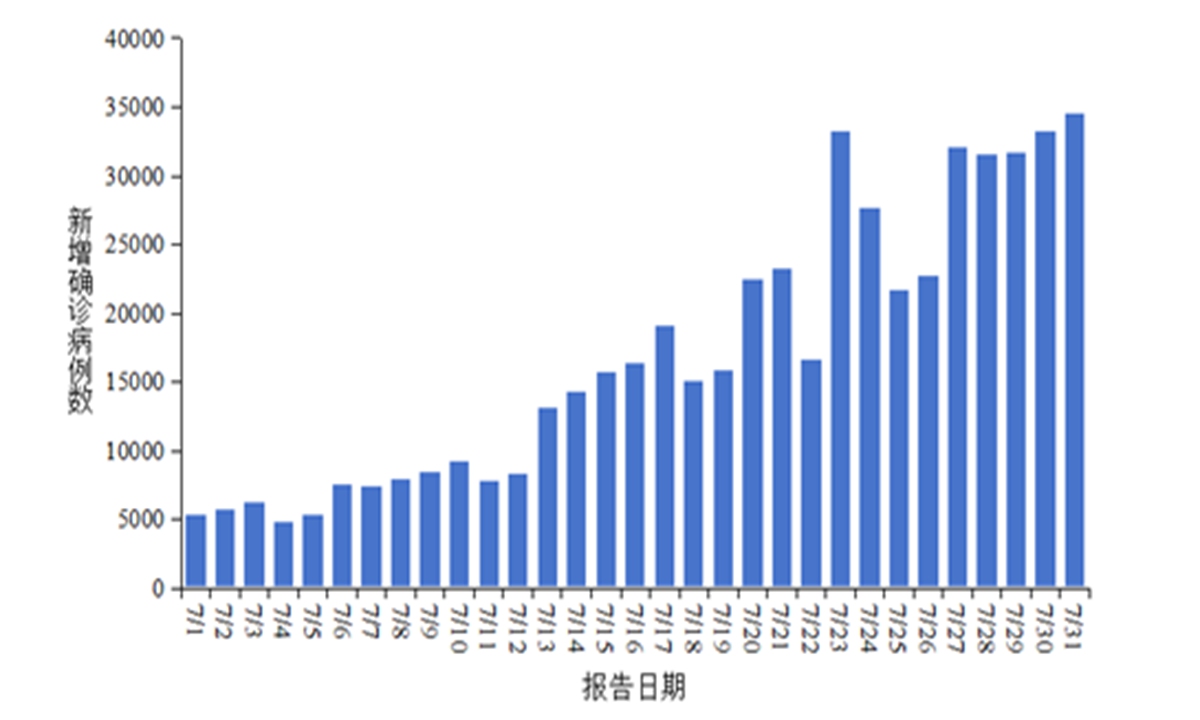
A screenshot from Chinese CDC report on new COVID-19 cases in July nationwide
According to sentinel hospital surveillance data, from June 29-July 5 to July 27-August 2, the proportion of influenza-like illness among all outpatient and emergency visits at China's 1,041 COVID-19 and influenza sentinel hospitals edged up with slight fluctuations, standing at 4.3 percent, 4.4 percent, 4.5 percent, 4.4 percent and 4.5 percent, respectively.
During the same period, the COVID-19 positivity rate among patients with influenza-like illness in outpatient and emergency departments rose for consecutive weeks.
Several factors drove the fluctuating rise in COVID-19 cases in July. Population immunity has waned, as more than six months have passed since the last major wave of infections for most people, while continued SARS-CoV-2 mutations have reduced the protection provided by existing antibodies, Li Tongzeng, a respiratory disease medic from Beijing You An Hospital to the Capital Medical University, told the Global Times on Friday.
These factors, combined with increased travel and population mobility during the summer vacation, contributed to the recent small-scale surge. Based on patterns observed in recent years, COVID-19 infections tend to rise every six to eight months as population immunity declines, said Li.
The expert noted that while the virus continues to mutate, there is no evidence that it has become more pathogenic. Clinical data show that most patients develop only mild symptoms, with very few progressing to pneumonia or requiring hospitalization.
The Chinese CDC noted on Thursday that since COVID-19 was reclassified as a Category B infectious disease under Category B management, it has evolved into a prevalent, recurring respiratory infectious disease in China, with one to two epidemic fluctuations occurring nationwide each year.
Li also noted that residual immunity from previous infections also helps reduce disease severity, with most reinfections presenting as mild upper respiratory symptoms that resolve within about a week. The single COVID-related death reported nationwide in July further indicates that the current fatality rate remains very low.
Judging from historical epidemic patterns and current case growth trajectories, national infection figures may begin to decline in late August. Nationwide case numbers are now nearly at their peak, with declines already observed in some regions, said Li.
The Chinese CDC also said on Thursday that surveillance had not detected any variants posing major public health risks, nor had the current wave caused notable disruptions to the healthcare system.
The public is advised to take appropriate protective measures, including wearing masks when necessary, maintaining good personal hygiene, adopting healthy lifestyles and getting vaccinated as recommended.
。

二 |
原标题:鸿海回应200亿美元半导体项目落户印度古吉拉特邦台湾《经济日报》消息,9月13日,印度大型跨国集团韦丹塔(Vedanta)与鸿海同印度古吉拉特邦签署协议,将在印度总理莫迪的家乡建设其200亿美元半导体项目。鸿海表示,很高兴古吉拉特邦所做的努力,以吸引在当地发展半导体与政府效率的提升,位于印度西部的古吉拉特邦是被认可具备工业发展、绿能与智慧城市的地方。随着基础建设的改善,以及政府主动强烈的支持,可望大幅提升在当地设立半导体厂的信心。返回搜狐,查看更多责任编辑:
。
Current article:http://t4nqoi.ninyakenhongnian.sbs/news/20260826_1890.html
Published on:13:37:49


 最强可达超强台风级!“沙德尔”会登陆我国吗?最新研判→
 西媒:巴尔韦德带伤踢了几场比赛,他不想关键时刻让球队失望
 斯洛伐克总理遭枪击,已进行手术,最新情况披露!欧洲多位政要发声
 腾讯张军回应“封锁”的提问:与产品交谈,不要上线。
 北京G4淘汰北控,赛后迎四好消息!2将拾巅峰,曾凡博三分蜕变!
 “孤儿怨”真人版 巴西37岁女子装12岁女孩被收养